
11 Mar 2026
Forex Card vs Cash for International Travel – What Actually Works Better?
If you’re planning to travel abroad, one question almost everyone asks at some point is this:
Should I carry foreign currency cash or a forex card?
Honestly, there is not a single perfect answer. After working in the forex industry and dealing with travelers almost every day, I have seen people use both sometimes very wisely, sometime not so wisely.
Some travelers depend completely on forex cards. Others carry only cash. Both approaches can create problems.
So, let’s talk about what actually works in real travel situations, not just theory.
First, Let’s Talk About Foreign Currency Cash
Cash is the most straightforward option. You exchange Indian Rupees to another currency like USD, Euro, Pound, Dirham, or something else and you carry those notes with you.
Simple. And to be honest, cash still solves a lot of problems when you are abroad.
Imagine landing in a new country after a long flight. Your phone battery is low, Wi-Fi is not working yet, and you need a taxi or coffee. In those situations, cash is the easiest thing in the world.
No machines. No PIN issues. No payment declines.
Just pay and move on.
That’s why most experienced travelers still keep some foreign currency in their wallet.
Where Cash Really Helps?
There are certain places where cards simply do not work that well.
- Street markets.
- Small cafes.
- Local taxis.
- Food stalls
If you have ever visited Southeast Asia or even parts of Europe, you will notice that many smaller shops prefer cash.
Another thing people forget is internet connectivity. Card machines sometimes fail if the network is poor. Cash does not have that problem.
But yes, cash is not perfect either.
The Biggest Problem with Carrying Too Much Cash
The obvious risk is losing it.
If you lose a wallet with foreign currency in it, there is not much anyone can do. No blocking. No recovery. It’s gone.
Another issue is the exchange rate when you return. Travelers often buy extra currency and then after the trip they have leftover notes. When converting it back to rupees, they usually lose a little money because the buy/sell rates are different.
Also, there are limits.
According to rules from the Reserve Bank of India, Indian travelers are usually allowed to carry up to USD 3,000 in foreign currency notes. Anything beyond that needs to be in other forms like forex cards.
Which brings us to the second option.
So, What Exactly Is a Forex Card?
Think of a forex card as a prepaid travel card.
You load foreign currency on it before your trip, and then use it abroad like a debit card.
- Swipe it at stores.
- Pay at hotels.
- Withdraw cash from ATMs.
Pretty convenient actually.
One thing people like is that the exchange rate is locked when you load the card. So, if the currency market changes later, it doesn’t affect the balance already on your card.
That gives travelers some peace of mind.
Why Many Travelers Prefer Forex Cards?
Safety is a big reason
If you lose the card, you can simply block it. In many cases, the bank or forex provider even gives a backup card.
That’s a huge advantage compared to cash.
Another good thing is that many forex cards support multiple currencies. So, if someone is traveling from Paris to London and then to Dubai, they can use the same card in all those places.
No need to carry different currency bundles.
For hotel payments or big shopping purchases, cards are usually easier anyway.
But Forex Cards Aren’t Perfect Either
People sometimes assume forex cards work everywhere. Not always.
- Small shops may refuse cards.
- Taxi drivers might prefer cash.
- Street markets definitely prefer cash.
Also, withdrawing money from ATMs abroad can involve fees depending on the card provider.
Not huge fees usually, but they exist.
Another small thing, some cards charge inactivity fees if you leave the balance unused for too long.
So yes, cards are useful, but relying only on them can be inconvenient.
What Usually Recommended to Travelers?
When customers ask us this question at the forex counter, we rarely suggest choosing just one option.
The smarter approach is a mix of both.
A typical recommendation looks something like this:
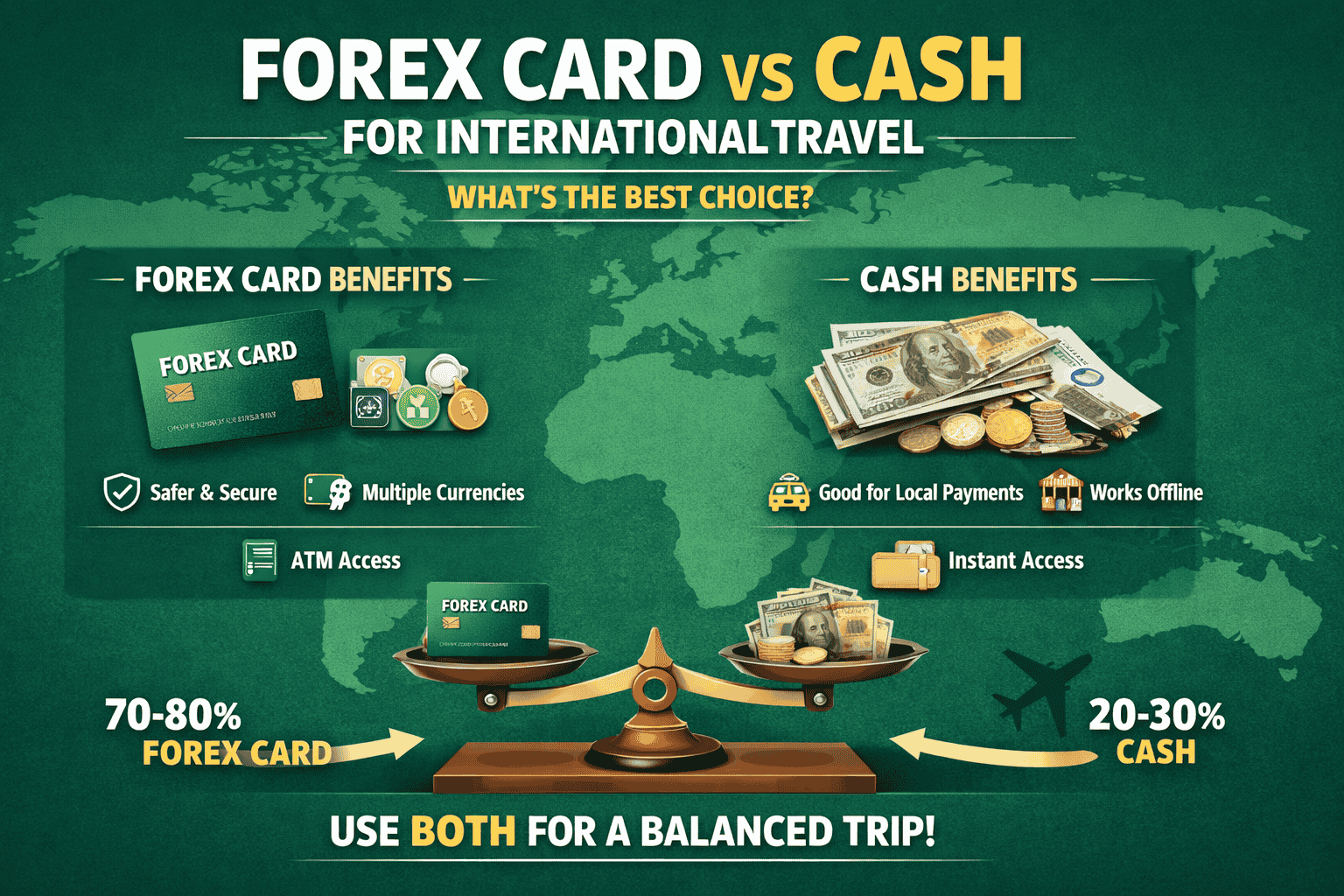
- Around 70–80% of your travel money on a forex card
- The remaining 20–30% in cash
This combination works well in most situations.
For example, if someone is traveling with around USD 5,000, a practical split could be:
- USD 3,500 loaded on a forex card
- USD 1,500 carried as cash
Now you’re covered everywhere like big stores, hotels, taxis, small markets, everything.
A Small Tip Many Travelers Don’t Know
Try to avoid exchanging currency at airports if possible.
Airport exchange counters often have higher margins. Sometimes the difference is small, sometimes it’s noticeable.
Buying forex from an authorized dealer before your trip usually gives you better value.
So, Which One Is Better?
If you’re looking for a simple answer, here it is.
Cash is great for small everyday spending.
Forex cards are better for larger payments and safety.
But the best strategy is the one most experienced traveler follows is using both together.
It is safer. More practical. And you’ll rarely find yourself stuck in a situation where you can not pay.